


Why Global OEMs Are Looking Beyond Traditional Supplier Networks
For decades, the playbook for original equipment manufacturers was remarkably stable: identify a handful of trusted suppliers, usually concentrated in a small number of low-cost

In industrial environments where safety, precision, and reliability are non-negotiable, data has become the most powerful driver of decision-making. Across sectors such as aerospace, automotive, semiconductor fabrication, heavy machinery, energy, materials engineering, and industrial automation, up to 60–70% of engineering decisions are made on the basis of test and measurement data.
But this data is meaningful only when the equipment capturing it is capable of withstanding the extreme conditions of real-world industrial testing. A mild fluctuation in temperature, a 2–3% sensor drift, or signal noise as low as 5–10 mV can distort a dataset enough to mislead entire engineering teams.
This is why industrial-grade test equipment must be engineered with exceptional robustness, thermal tolerance, vibration resistance, and long-term stability. The precision of modern data management systems—AI analytics, real-time monitoring, digital twins—depends fundamentally on the integrity of the raw data fed into them.
Machine Maze, an advanced manufacturer of high-performance test technologies, builds equipment engineered to survive harsh conditions and deliver uncompromised accuracy. This article dives deep into why technical strength in test equipment is essential for strong data management, backed by quantifiable engineering realities.
Modern heavy industries generate staggering volumes of test data:
In such environments, data precision = operational safety + product quality + regulatory compliance.
Any corruption at the acquisition stage has a downstream impact on:
A 1% measurement error during early testing can balloon into 15–20% miscalculation during lifecycle modeling.
This places an enormous responsibility on the equipment collecting and conditioning the data.

Heavy industrial testing often pushes equipment beyond conventional operating limits. The environment itself introduces disruptive forces:
Thermal tests in aerospace, metallurgy, and energy applications frequently reach:
Most sensors begin to drift at >80°C, and standard electronics degrade significantly at >120°C. Only thermally hardened components maintain accuracy at elevated temperatures.
2. High Vibration & Shock Loads (5–40 g RMS)
In mechanical testing:
Weak instrument housing or poor mechanical isolation can shift sensor positioning by as little as 0.5 mm, which can distort readings by 3–4%.
3. Signal Noise & Electromagnetic Interference
Factories contain:
These can induce 20–60 mV of electrical noise, corrupting precision sensor signals.
4.Environmental Exposure: Dust, Moisture & Corrosives
Humidity above 85% RH, dust > PM 2.5, and corrosive particles like SO₂ or NOx can degrade connectors, leading to intermittent signal drops.
5. Long-Cycle Tests (10,000–50,000 hours)
Applications such as endurance, fatigue, thermal aging, and reliability testing often run continuously for months or years. Equipment must maintain:
These challenges demand high-strength, resilient equipment.
To withstand harsh environments, test equipment must combine mechanical, thermal, electrical, and material engineering excellence.
High-strength alloys, reinforced mountings, and vibration-tolerant designs are essential.
Key engineering parameters:
Thermal-resistant materials and insulated electronics must handle:
Ceramic insulation, thermally compensated circuits, and high-temperature connectors make this possible.
Robust electronics design includes:
Modern industrial tests demand:
This ensures stable, high-fidelity data.
Equipment must maintain specifications for years:
Long-term stability is the backbone of continuous testing applications.
Strong data begins with strong equipment. When durable test systems operate reliably under extreme conditions, they improve every downstream process in the data management chain.
With low noise and high accuracy, engineers can trust:
High-quality input improves:
A slight noise reduction (10–15%) can increase model accuracy by up to 40%.
Failproof equipment reduces:
Industries like aerospace and automotive require:
Equipment with rugged engineering simplifies the audit path.
Machine Maze stands at the forefront of manufacturing test technologies engineered specifically for heavy and critical industries. As a proud creator of robust testing solutions, the company focuses on the fundamental truth: data quality starts with equipment quality.
Machine Maze’s manufacturing philosophy blends precision engineering with rugged design, ensuring that every product can:
From material selection to circuit design, signal processing, and enclosure engineering, every detail is optimized for durability and accuracy. Machine Maze products are built not just to measure—but to endure.
The result is test equipment that serves as a reliable backbone for industries where every data point matters.
As industries move toward AI-driven and digital-twin–driven operations, the demand for extremely accurate field data will grow rapidly. Key trends include:
– Self-calibrating sensors with <10 ppm drift
– High-frequency wireless sensing up to 1 MHz
– Edge AI analytics reducing data load by 30–70%
– Ultra-high-temp probes up to 1000°C
– Long-range digital diagnostics over IIoT systems
Machine Maze is investing heavily in these future technologies to help industries remain competitive in a global digital landscape.
In heavy and high-tech industries, data is the backbone of engineering success. But to manage data effectively, the tools used to collect it must be engineered to withstand extreme conditions. High temperatures, intense vibration, corrosive atmospheres, electrical noise, and long testing cycles create environments where only robust, resilient test equipment can survive.
When test technology is strong, the entire data management ecosystem becomes stronger—leading to better analytics, more reliable predictions, safer operations, and higher-quality products.
Machine Maze stands at the forefront of this transformation, designing test equipment that combines ruggedness with precision, durability with accuracy, and endurance with intelligence. For industries that rely on every data point, this strength makes all the difference.
For decades, the playbook for original equipment manufacturers was remarkably stable: identify a handful of trusted suppliers, usually concentrated in a small number of low-cost

Energy costs remain elevated. Skilled labor is scarce and expensive. Regulatory and compliance overheads keep climbing. Meanwhile, the pressure to deliver vehicles at competitive price
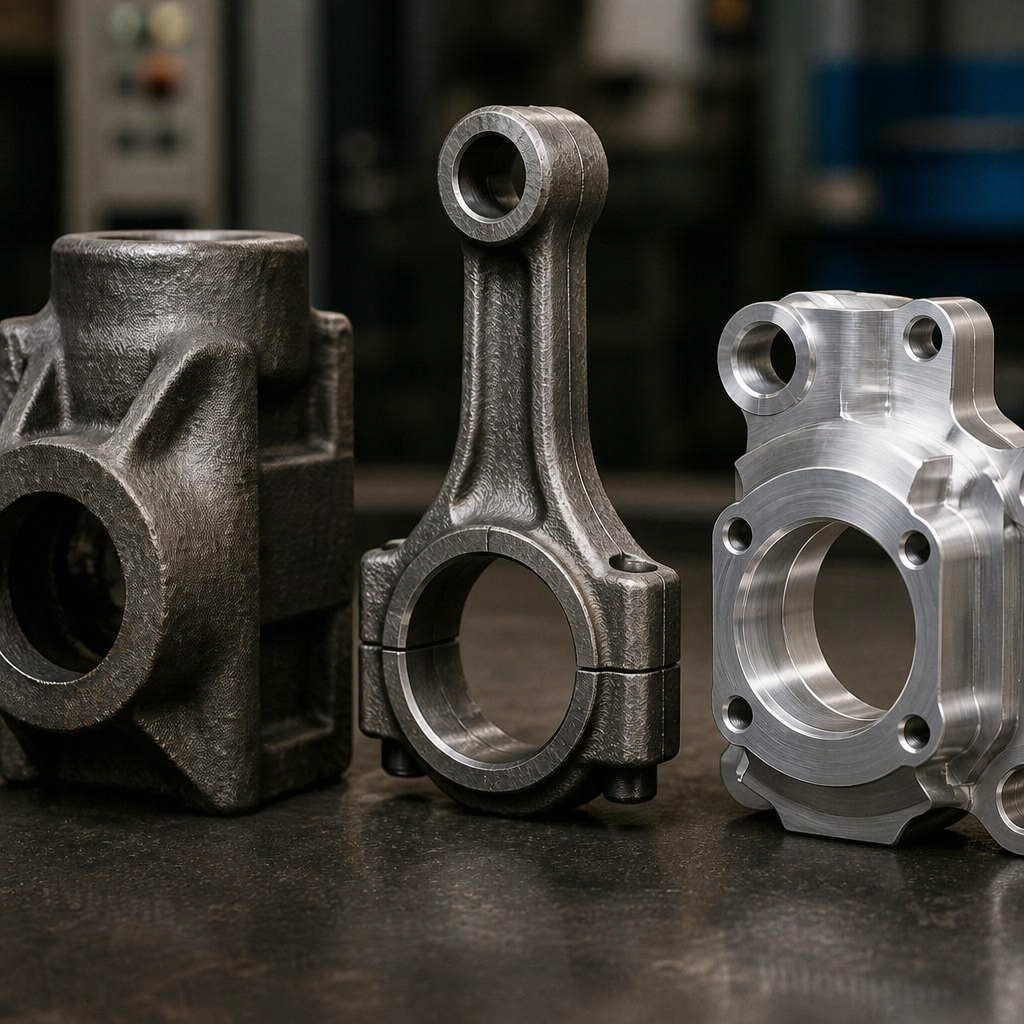
Choosing the right manufacturing process is one of the most consequential decisions an OEM makes before a part ever reaches production. Casting, forging, and machining