
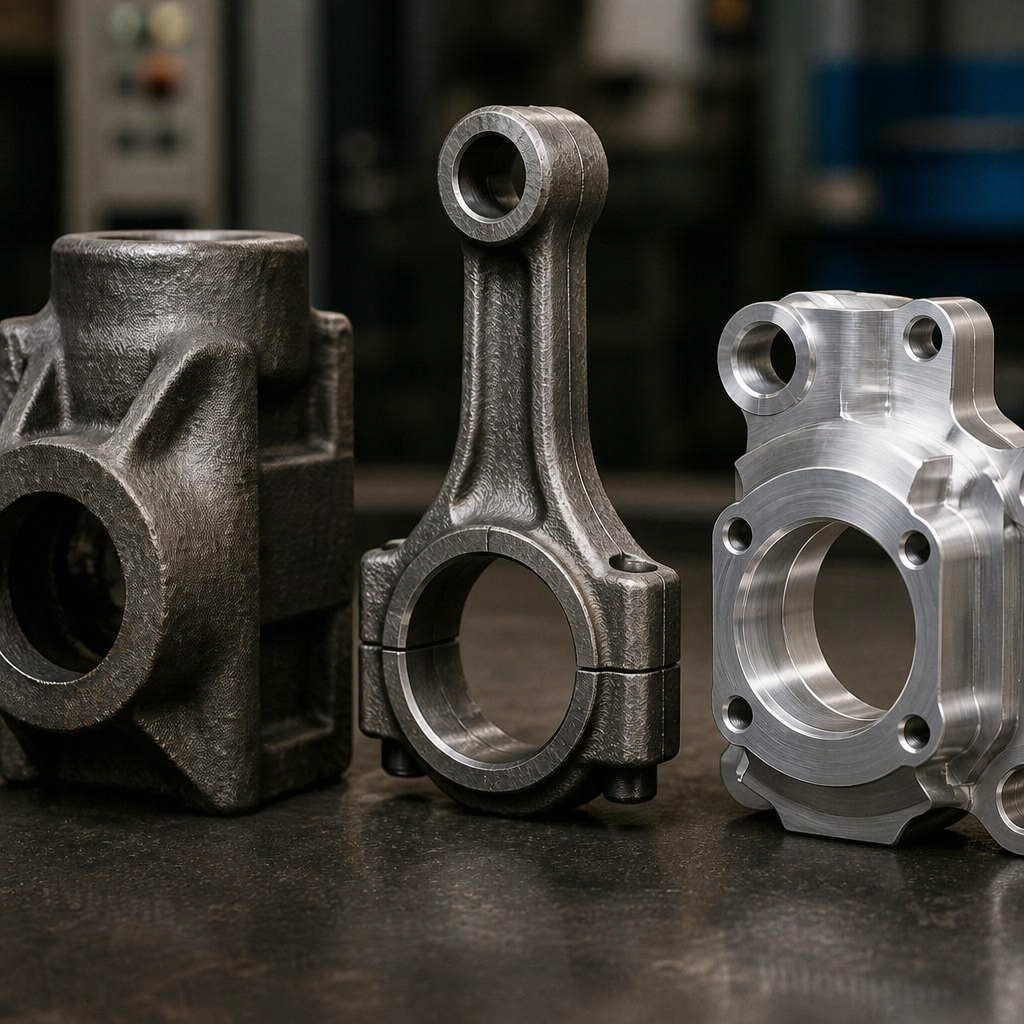
Choosing the right manufacturing process is one of the most consequential decisions an OEM makes before a part ever reaches production. Casting, forging, and machining each produce metal components in fundamentally different ways and each comes with its own trade-offs in strength, tolerance, cost, and lead time. Picking the wrong one can mean paying for precision you don’t need, or worse, ending up with a part that fails under load it was never designed to handle.
This guide breaks down how each process works, where it excels, where it falls short, and how to decide which one fits your application.
What Is Casting?
Casting involves pouring molten metal into a mold shaped like the desired part. Once the metal cools and solidifies, the mold is removed (or broken away, depending on the method) to reveal the final geometry. Common casting methods include sand casting, investment casting, die casting, and gravity casting.
Strengths of casting:
- Excellent for complex geometries, internal cavities, and intricate shapes that would be difficult or impossible to machine
- Cost-effective for medium to high production volumes once tooling is amortized
- Works well with a wide range of metals, including aluminum, iron, steel, and various alloys
- Minimal material waste since metal is poured to near-final shape
Limitations of casting:
- Porosity and internal voids can occur, affecting structural integrity
- Grain structure is generally less refined than forged parts, which can reduce mechanical strength
- Tolerances are typically looser than machining, often requiring secondary finishing operations
- Tooling costs and lead times for mold creation can be significant for low-volume runs
Best suited for: Engine blocks, pump housings, valve bodies, brackets, and other parts with complex internal or external geometry where moderate strength requirements are acceptable.
Check Article : Sustainable Practices in Ferrous Casting Manufacturing
What Is Forging?
Forging shapes metal using compressive forces typically through hammering, pressing, or rolling while the material is heated (hot forging) or at room temperature (cold forging). Rather than melting the metal, forging deforms it, aligning the internal grain structure along the contours of the part.
Strengths of forging: Because the grain flow follows the shape of the component, forged parts exhibit superior strength, toughness, and fatigue resistance compared to cast or machined equivalents. This makes forging the process of choice for components that experience high stress, impact, or cyclical loading.
- Superior mechanical properties: higher strength-to-weight ratio, better impact resistance, improved fatigue life
- Refined, directional grain structure that enhances durability
- Reduced risk of internal voids or porosity compared to casting
- Well suited for critical, load-bearing components
Limitations of forging:
- Tooling and die costs are high, making it less economical for low volumes or highly complex shapes
- Design flexibility is more limited than casting deep cavities and intricate internal features are difficult to achieve
- Often requires secondary machining to reach final tolerances and surface finish
- Longer lead times for die development
Best suited for: Crankshafts, gears, connecting rods, fasteners, structural automotive and aerospace components, and any part subjected to high mechanical stress or fatigue loading.
What Is Machining?
Machining is a subtractive process material is removed from a solid workpiece (billet, bar stock, or a pre-cast/pre-forged blank) using cutting tools to achieve the final shape. CNC turning, milling, drilling, and grinding are the most common machining operations in precision manufacturing today.
Strengths of machining:
- Achieves the tightest tolerances and finest surface finishes of the three processes
- Highly repeatable and consistent, part after part
- No tooling investment required for low-volume or prototype runs, since CNC programs can be adjusted digitally
- Ideal for parts requiring precise dimensional accuracy, threading, or fine features
Limitations of machining:
- Generates more material waste compared to casting or forging, since material is cut away rather than shaped
- Can be less cost-effective at very high volumes compared to casting or forging with established tooling
- Complex internal geometries can be difficult or impossible to achieve without multi-axis setups
Best suited for: Precision-turned components, tight-tolerance shafts, custom fixtures, prototypes, and any part where dimensional accuracy and surface finish are non-negotiable.
Casting vs Forging vs Machining: Side-by-Side Comparison
| Factor | Casting | Forging | Machining |
| Strength & durability | Moderate | High | Depends on base material |
| Tolerance & precision | Loose to moderate | Moderate (often needs finishing) | Tightest |
| Design complexity | High (complex geometries) | Moderate | High with multi-axis CNC |
| Material waste | Low | Low | Higher |
| Tooling cost | Moderate to high | High | Low to none |
| Best for volume | Medium to high | Medium to high | Low to high (flexible) |
| Lead time (low volume) | Slower (mold creation) | Slower (die creation) | Fast |
| Typical use case | Housings, complex shapes | Load-bearing, high-stress parts | Precision, tight-tolerance parts |
How to Choose the Right Process
There’s no single “best” process the right choice depends on the part’s function, load requirements, volume, and budget.
- Does the part need to withstand high stress or fatigue loading? If yes, forging is usually the stronger choice.
- Does the part have complex internal geometry or cavities? Casting is often the most practical and economical route.
- Does the part require tight tolerances, fine finishes, or is it a low-volume/prototype run? Machining offers the precision and flexibility needed.
- What’s the production volume? High-volume programs can better absorb the tooling costs of casting and forging, while machining remains cost-effective across a wider volume range without upfront tooling investment.
In many real-world applications, these processes aren’t mutually exclusive a forged or cast blank is often finish-machined to achieve the tight tolerances and surface quality that the final application demands. Understanding how to combine processes intelligently is often just as valuable as choosing a single one.
Getting the Process Selection Right, From the Start
Choosing between casting, forging, and machining shouldn’t be a guessing game it should be based on a clear understanding of load requirements, tolerances, volumes, and total landed cost. At MachineMaze, we work with OEMs to evaluate the right process (or combination of processes) for each component, backed by an AI-powered quoting engine that turns around RFQs in under an hour so you get clarity on cost and feasibility fast, without weeks of back-and-forth.
Precision components manufactured in India and delivered globally, across casting, forging, and machining, tailored to your specifications.
Have a part in mind? Get a quote from MachineMaze and see how fast precision manufacturing decisions can move.