
Plastic injection molding plays a critical role in modern industrial manufacturing and engineering manufacturing, enabling the production of highly precise plastic components used in industries such as automotive, aerospace, medical devices, and electronics. Companies offering contract manufacturing and custom injection molding services rely heavily on stable and predictable processes to ensure that the final plastic parts meet strict dimensional tolerances.
However, one of the most common challenges in plastic injection molding is plastic part shrinkage. Shrinkage can affect the size, structural integrity, and performance of plastic components, especially in high-precision applications like plastic parts for automotive and aerospace industries.
Let’s see why shrinkage occurs and how plastic raw material selection influences it is essential for manufacturers aiming to maintain consistent quality and production efficiency.
Introduction About Plastic Part Shrinkage
Plastic shrinkage is a natural phenomenon that occurs when molten plastic cools and solidifies inside a mold cavity. During the injection molding process, plastic resin is heated until it becomes molten and then injected into a mold under high pressure. As the material cools, it contracts, causing dimensional changes in the molded part.
In engineering manufacturing, even a small shrinkage variation can create serious issues such as:
- Dimensional inaccuracies
- Assembly misalignment
- Structural weakness
- Increased rejection rates
Industries such as automotive and aerospace demand extremely tight tolerances. For example:
- Automotive plastic components often require tolerances within ±0.05 mm
- Aerospace components may require tolerances tighter than ±0.02 mm
This makes controlling shrinkage a critical factor in successful custom injection molding services.
What is Plastic Part Shrinkage?
Plastic part shrinkage refers to the reduction in size of a molded plastic component as it cools from its molten state to room temperature.
Shrinkage is typically measured as a percentage of dimensional reduction. Different plastic raw materials have different shrinkage rates depending on their molecular structure.
Typical shrinkage ranges in plastic injection molding include:
| Plastic Material | Typical Shrinkage Range |
| ABS | 0.4% – 0.7% |
| Polycarbonate (PC) | 0.5% – 0.7% |
| Nylon (PA) | 1.0% – 2.0% |
| Polypropylene (PP) | 1.0% – 2.5% |
| HDPE | 1.5% – 3.0% |
In high-performance applications such as aerospace connectors or automotive interior components, even 0.1% shrinkage variation can lead to component failure or improper fitting.
How Designing Mold Matters in Plastic Injection Molding Shrinkage
Mold design is one of the most important factors in controlling shrinkage. In contract manufacturing, molds must be engineered to compensate for expected shrinkage during the cooling process.
A well-designed mold includes:
1. Shrinkage Compensation
Engineers design the mold cavity slightly larger than the desired final dimension. The expected shrinkage percentage is calculated based on the selected plastic raw material.
Example:
If the final component must be 100 mm, and the material shrinkage rate is 1.5%, the mold cavity may be designed around 101.5 mm.
2. Uniform Wall Thickness
Uneven wall thickness leads to inconsistent cooling rates, which causes warping and uneven shrinkage.
Best practice:
- Maintain consistent wall thickness
- Avoid sudden geometry transitions
3. Proper Gate Design
The gate controls how molten plastic enters the mold. Poor gate design can cause uneven packing pressure, resulting in inconsistent shrinkage.
4. Cooling Channel Design
Efficient cooling channels ensure uniform cooling across the entire mold cavity. Uneven cooling can create internal stress and dimensional distortion.
For manufacturers offering custom injection molding services, optimized mold design is essential to reduce defects and maintain production efficiency.
What Causes Plastic Part Shrinkage?
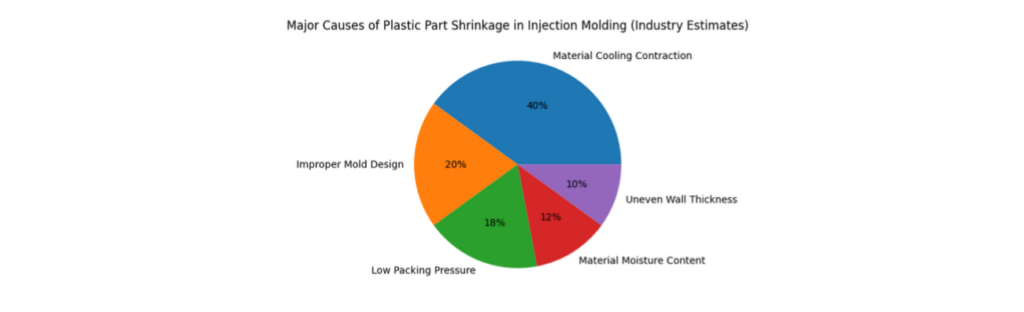
Shrinkage in injection molded plastic parts can occur due to several factors related to material behavior, process conditions, and mold design.
The chart below illustrates the major causes of shrinkage in plastic injection molding.
Key contributors include:
1. Material Cooling Contraction (≈40%)
When plastic cools from its molten state, molecular chains contract and settle into a more compact structure.
Crystalline plastics such as:
- Polypropylene (PP)
- Nylon (PA)
- HDPE
tend to shrink more compared to amorphous plastics like:
- ABS
- Polycarbonate
2. Improper Mold Design (≈20%)
Poor mold geometry can lead to uneven cooling and inconsistent pressure distribution.
3. Low Packing Pressure (≈18%)
During the packing phase of injection molding, pressure is applied to compensate for material shrinkage. If packing pressure is insufficient, voids and shrinkage defects may occur.
4. Material Moisture Content (≈12%)
Excess moisture in plastic raw material can lead to inconsistent shrinkage and surface defects.
5. Uneven Wall Thickness (≈10%)
Thicker areas cool slower, causing localized shrinkage and warping.
How Shrinkage Affects Industrial Applications
Shrinkage can significantly impact the performance of components used in industrial manufacturing.
Automotive Industry
Automotive components such as dashboards, air vents, and sensor housings must maintain precise dimensions.
Shrinkage issues can cause:
- Poor assembly alignment
- Increased vibration
- Structural failure
Aerospace Industry
Aerospace plastic components are often used in:
- Lightweight brackets
- Cable housings
- Instrument panels
In this industry, even minor dimensional variation can affect system reliability and safety.
Electronics Manufacturing
Shrinkage can cause issues such as:
- Misalignment in connectors
- Poor enclosure fitting
- Reduced structural strength
This is why selecting the right plastic raw material is essential for contract manufacturing companies.
Shrinkage Behavior of Different Plastic Materials
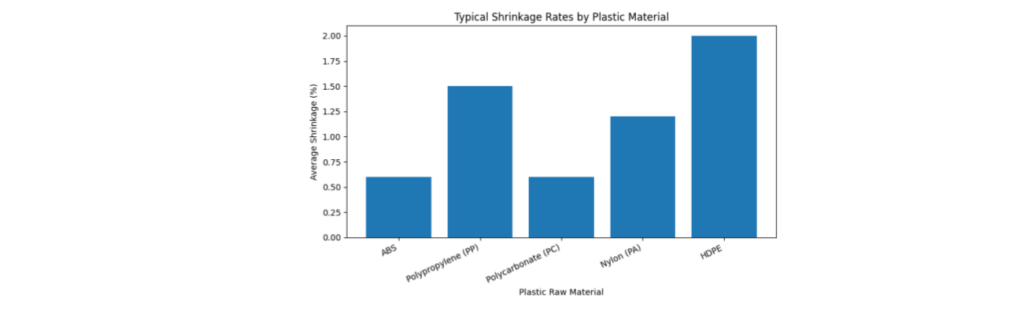
The graph shows average shrinkage rates across common plastic materials used in engineering manufacturing.
Key observations:
- HDPE has the highest shrinkage rate (around 2%)
- Polypropylene (PP) also has relatively high shrinkage
- ABS and Polycarbonate show lower shrinkage levels
This is why ABS and PC are widely used in precision plastic components.
Effect of Moisture on Plastic Shrinkage
Moisture in raw materials can cause unpredictable shrinkage behavior.

As shown in the graph:
- When moisture content increases from 0.02% to 0.30%
- Shrinkage variation increases significantly
This is why plastic resins are often dried before injection molding.
Drying conditions typically include:
- 80°C – 120°C drying temperature
- 2–4 hours drying time depending on material
Check Here –> Plastic Injection Molding Materials Explained
How to Prevent Plastic Shrinkage Fluctuation
Preventing shrinkage fluctuation requires a combination of material selection, mold design, and process optimization.
1. Use High-Quality Plastic Raw Material
Consistent resin quality ensures predictable shrinkage behavior.
Manufacturers should select:
- Certified suppliers
- Low-moisture resins
- Engineering-grade polymers
2. Optimize Mold Design
Proper mold design should include:
- Uniform wall thickness
- Efficient cooling channels
- Balanced gate placement
3. Control Injection Parameters
Important parameters include:
- Injection pressure
- Packing pressure
- Cooling time
- Mold temperature
Optimizing these parameters helps reduce internal stress and shrinkage defects.
4. Pre-Dry Plastic Materials
Moisture control is critical, especially for hygroscopic plastics such as:
- Nylon (PA)
- Polycarbonate (PC)
- PET
5. Conduct Shrinkage Simulation
Advanced manufacturing companies use mold flow simulation software to predict shrinkage before production.
This helps engineers adjust mold designs before expensive tooling is manufactured.
A quick thought —
Plastic shrinkage is an unavoidable phenomenon in plastic injection molding, but with the right engineering practices it can be effectively controlled.
For companies offering contract manufacturing and custom injection molding services, managing shrinkage is essential for delivering high-quality plastic components used in automotive and aerospace industries.
Key strategies include:
- Selecting the right plastic raw material
- Designing molds that compensate for shrinkage
- Maintaining controlled processing conditions
- Ensuring proper material drying and quality checks
By combining material science, precision mold design, and optimized manufacturing processes, modern industrial manufacturing companies can significantly reduce shrinkage defects and produce reliable, high-performance plastic components.
The MachineMaze Approach to Reliable Plastic Injection Manufacturing
At MachineMaze, quality and consistency in plastic injection molding begin with the right materials. For critical applications across automotive, aerospace, and industrial manufacturing, MachineMaze carefully sources plastic raw materials from expert and certified vendors who meet global material standards and compliance requirements. This ensures predictable material behavior, controlled shrinkage rates, and high dimensional accuracy in every molded component. By combining trusted raw material sourcing, advanced mold engineering, and precision-driven contract manufacturing processes, MachineMaze supports global OEMs with reliable custom injection molding services that deliver consistent quality, performance, and scalability for complex engineering applications.